Unleash Nostalgia: The Vintage Green Butterfly Junk Journal Collection
In the world of creative assets, finding a design resource that balances aesthetic appeal with practical utility is often the hardest part of the process. The Vintage Green Butterfly Junk Journal collection serves as a perfect example of how digital design assets can bridge the gap between high-end visual art and everyday crafting needs. This collection is not just a set of files; it is a curated atmosphere, offering a distinct personality that leans heavily into the "cottagecore" and botanical trends dominating modern visual culture.
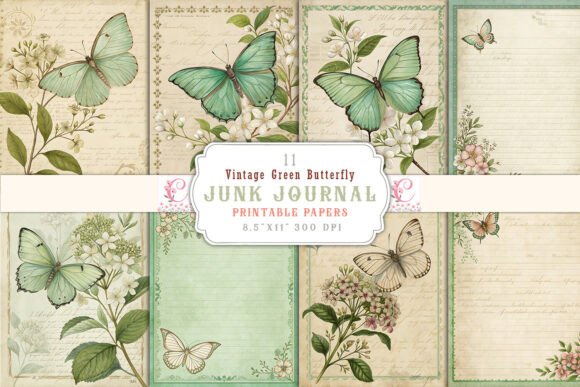
At its core, this package consists of 11 distinct high-resolution JPG files. The dimensions are set at a generous 8.5 x 11 inches at 300 DPI, ensuring that the details remain crisp whether you are viewing them on a screen or holding the final printed product. The visual language of the collection revolves around a specific palette of sage and moss greens, complemented by the intricate, delicate geometry of butterfly wings. It evokes a sense of history—specifically the Victorian era of natural history journals—while remaining versatile enough for contemporary graphic design trends.
The Anatomy of the Aesthetic
Understanding the visual characteristics of the Vintage Green Butterfly Junk Journal is key to utilizing it effectively. The style does not rely on bold, aggressive typography or neon colors. Instead, it prioritizes texture, layering, and a muted color theory. The "personality" of these pages is introspective, organic, and slightly weathered. You will notice subtle grain and texture that mimics aged paper, which is crucial for adding depth to mixed media projects.
For designers and brand strategists, this specific aesthetic speaks to a desire for authenticity. In an era of hyper-polished, flat digital design, the tactile appearance of these journal pages offers a refreshing contrast. The green tones are psychologically associated with growth, nature, and tranquility. When applied to a brand identity, these colors can help position a product as eco-friendly, grounded, or artisanal. The butterfly motifs add a layer of metamorphosis and freedom, making this collection particularly suitable for brands in the wellness, lifestyle, or botanical sectors.
Practical Applications for Modern Creatives
While the name suggests a specific use case, the utility of the Vintage Green Butterfly Junk Journal extends far beyond traditional journaling. As a creative professional, you should view these files as a toolkit for building complex visual narratives. Here is how different segments of the creative industry can leverage these assets:
- Editorial Design and Publishing: If you are working on a digital magazine or a self-published book, these pages serve as excellent background layers. They provide a texture that makes text-heavy pages more inviting without overwhelming the reader. They work beautifully as chapter dividers or decorative margins in a planner layout.
- Scrapbooking and Ephemera: For the hobbyist or professional scrapbooker, the 8.5 x 11 inch format is ideal for creating inserts. You can print these pages and tear the edges to create a true ephemera effect, adding physical dimension to a photo album or memory box.
- Handmade Crafts and Packaging: Small business owners can use these files to create unique packaging elements. Imagine a handmade soap company wrapping their bars in a printed sheet from this collection, or a jewelry maker using a cropped section as a backing card for earrings. It instantly elevates the perceived value of the product.
- Digital Content Creation: Bloggers and social media managers can utilize these images as backgrounds for quotes, testimonials, or promotional graphics. The vintage style stands out in a feed dominated by stark minimalism, helping to increase engagement through visual curiosity.
Design Strategy: Integration and Pairing
When incorporating the Vintage Green Butterfly Junk Journal into a larger design system, typography selection is critical. Because the background features organic, illustrative elements, your primary typeface should offer contrast to maintain readability.
For a modern, high-contrast look, consider pairing these backgrounds with a clean sans serif font. The geometric simplicity of a sans serif typeface will cut through the texture of the journal pages, ensuring that your headers and body copy remain legible. Conversely, if you are aiming for a fully cohesive vintage aesthetic, a script font or a handwritten font can be used for headers, provided the text size is large enough. However, be cautious with heavy serif fonts at small sizes, as the background texture can sometimes interfere with the legibility of fine serifs.
From a visual hierarchy perspective, use the full pages as backgrounds for your main focal points. If you need to place text over a busy section of the page, consider using a semi-transparent overlay or a text box with a solid, muted background color drawn from the page's own palette. This ensures the vintage aesthetic is present but does not compromise the communication of the message.
Technical Execution and Workflow
The usability of a design asset often comes down to the technical specifications. The Vintage Green Butterfly Junk Journal is delivered as a ZIP folder containing high-resolution JPGs. It is important to note that these are raster images, not vector files. This means they have a fixed resolution. While 300 DPI is perfect for print, you should avoid scaling these images up significantly for large-format printing (like posters or banners) to prevent pixelation.
For those using software like Adobe Photoshop, Procreate, or Canva, these files act as immediate backgrounds. You can apply blending modes—such as "Multiply" or "Overlay"—to integrate other design elements seamlessly. For example, placing a black and white photo over the green butterfly page and setting the layer to "Multiply" will create a stunning, integrated mixed-media effect where the texture of the paper bleeds through the image.
Licensing and Commercial Use
Before using the Vintage Green Butterfly Junk Journal in a commercial project, it is always best practice to review the licensing terms associated with the download. In the world of digital assets, the distinction between personal use and commercial use is vital. Most premium assets allow for commercial use in end products (like a printed invitation or a flattened digital graphic), but restrict the resale of the raw digital files themselves.
Always ensure that your final deliverable is a unique composition that utilizes the asset as a component, rather than the asset being the entire product itself. This protects both the original creator and your business integrity.
Final Thoughts on Creative Utility
The Vintage Green Butterfly Junk Journal